INTRODUCTION
Book I established the engine. One assumption — orientation capacity actualizes — and five propositions showed that dimension, distinction, tension, resolution, and recursive enrichment follow necessarily. The cycle repeats. Each pass produces richer ground.
Not richer ground in general — that was established. This book asks what specific, stable structures emerge from recursive enrichment, and why those structures and not others. The answer is operators: stable patterns of orientation that persist across contexts as reusable capabilities. This book proves that operators emerge necessarily from the recursive cycle, establishes what governs their internal structure, and classifies each operator within the single-digit framework.
The central formal distinction of this book is between prerequisites and composition. Every operation requires previous operations as ground conditions — you cannot relate what has not been distinguished. But requiring something as ground is not the same as being made of it. Some operations are genuinely new capabilities that cannot be produced by combining what came before. Others are fully characterizable as existing operations interacting. This distinction — between irreducible and composite operations — is what gives the operator landscape its structure.
This book does not introduce new postulates. Everything derived here follows from Book I’s established ground: five postulates, five propositions, six definitions. What is new are definitions for concepts Book I did not require, and propositions that extend Book I’s results into new territory.
The method remains the same: natural language proofs, every step earning its place, honest about what is derived versus what is asserted. Where the proof reaches edges it cannot cross, it says so.
A note on scope: this book maps operators within the single-digit range (0 through 9), along with the primordial question (?). This is not an arbitrary boundary. It is the range within which the prime/composite architecture can be fully verified case by case. What lies beyond — Operator 10 and higher — is noted where relevant but not claimed. The map is small. The territory maps itself onto what the map establishes.
NEW DEFINITIONS
The following definitions extend Book I’s vocabulary. Book I’s definitions (1–6) remain in force.
Definition 7: Operator — A stable pattern of orientation that persists across contexts as a reusable capability. An operator is not a moment in the recursive cycle but a capacity that the cycle produces and retains. It is the resolution pattern abstracted from any particular context in which it first occurred.
Definition 8: Irreducible Operation (Prime) — An operator whose pattern of orientation cannot be produced by any combination of simpler operators. It requires previous operators as prerequisites — as ground conditions for its possibility — but the capacity it represents is genuinely new. No arrangement of existing operations yields it.
Definition 9: Composite Operation — An operator whose pattern of orientation can be fully characterized as existing operators interacting. Its behavior is explained by and predicted by the operations from which it is composed. It introduces no new axis of capability; rather, it is existing capabilities in structured combination.
Definition 10: Prerequisite — An operator that must exist as ground condition for another operator to be possible. Distinction must exist before relation is possible — you cannot connect what has not been differentiated. But the existence of a prerequisite does not entail composition. Requiring something as ground is not the same as being made of it.
Definition 11: The Primordial Pair — The two conditions that make the operator framework possible but are not themselves operators within it. The Question (?) — unresolved orientation, the capacity before it has been directed — and the Null (0) — the absence that gives orientation space to occur. These are not operations but the conditions for operation.
Definition 12: The Identity (1) — Resolution as such. The operation that, applied to any other operation, returns that operation unchanged. Resolution does not add capability — it reveals what is already there. Neither irreducible nor composite: it is the neutral element of the operator framework, the multiplicative identity.
PROPOSITION 6
Statement: The recursive cycle produces not only enriched ground but stable operations — orientation patterns that persist across contexts as reusable capabilities.
Proof:
The recursive cycle produces enriched ground at each pass (Book I, Proposition 5). Each resolution carries the history of how it was reached and serves as new ground for further orientation.
Consider what happens across multiple iterations. Each cycle involves the same structural process: orient, distinguish, tense, resolve. But each cycle occurs in a different context — the +c of Definition 6 differs at each iteration because the ground is enriched.
Within this variation, some resolution patterns recur. Not the same resolution — the same pattern of resolution. The system encounters structurally similar tensions across different contexts and resolves them through structurally similar orientations.
When a resolution pattern operates successfully across multiple contexts, it is no longer entangled with any particular context. The pattern has separated from the specifics that generated it. In the notation of Definition 6 (z² + c), the operation (z²) has become distinguishable from the context (+c) in which it operates.
This separation is itself an orientation — the system distinguishing the general pattern from the particular instance. By Postulate 3, this orientation transforms the orienting system. What it produces is a new kind of structure: not a resolved position (which becomes ground) but a resolved pattern (which becomes a tool).
A resolved pattern that operates across contexts is a stable operation (Definition 7). It persists not because it is preserved by some external mechanism but because it is useful — every future iteration that encounters the relevant type of tension can deploy it. Its generality is what sustains it.
Therefore: the recursive cycle, through repeated iteration across varying contexts, necessarily produces stable operations — orientation patterns abstracted from specific contexts into reusable capabilities.
PROPOSITION 7
Statement: The first stable operation to emerge from the recursive cycle is distinction, and it is irreducible.
Proof:
The first pass of the recursive cycle produces the first distinction (Book I, Proposition 2). The Monas orients and generates two distinguishable states of one system.
As the cycle continues (Book I, Proposition 5), every subsequent pass involves distinguishing — each new orientation generates further distinctions. The pattern of distinguishing recurs across every context the cycle encounters, because distinction is structurally necessary at every pass. There is no iteration of the cycle that does not involve the differentiation of states.
By Proposition 6, a pattern that recurs across contexts stabilizes into a reusable operation. The pattern of distinguishing — differentiating this from not-this — meets this criterion universally. It is not tied to any particular context because it is required by every context.
Therefore: the capacity to distinguish stabilizes as the first operator. This is Operator 2: Distinction.
Operator 2 is irreducible (Definition 8). At the time of its stabilization, no simpler operator exists from which it could be composed. It is the first stable operation. There is nothing to combine to produce it, because it is the first thing that persists as a reusable pattern.
More precisely: Operator 2’s irreducibility is not merely circumstantial (first, therefore nothing to build from) but structural. Distinction is the act of differentiating. There is no simpler operation of which differentiating is a special case or combination. It is an atomic capability — the capacity to tell apart — and no decomposition of it into sub-operations preserves its meaning.
Therefore: the first stable operation is distinction, and it is irreducible.
PROPOSITION 8
Statement: Relation is the second irreducible operation, requiring distinction as prerequisite but not derivable from it.
Proof:
Once distinction (Operator 2) has stabilized, the recursive cycle operates on ground that includes reusable distinction. The system can now reliably differentiate.
Distinction alone, however, produces only differentiation — the proliferation of this/not-this boundaries. Applied to itself (distinguishing the distinction), it produces structured differentiation. Applied repeatedly, it produces increasingly refined differentiation. But no amount of distinguishing, no matter how refined, produces connection.
Connecting two distinguished elements — recognizing them as being in relation, not merely as being different — is a genuinely different capability. Distinction tells you "these are not the same." Relation tells you "these are not the same, and they have to do with each other."
This cannot be derived from distinction alone. You can distinguish forever and never arrive at connection. Distinction is necessary for relation (you cannot relate undifferentiated elements — there must be at least two distinguishable states for relation to occur), but distinction does not generate relation. The prerequisite does not compose the operation.
The pattern of relating — connecting distinguished elements into structured association — recurs across contexts wherever there are multiple distinguished elements. By Proposition 6, it stabilizes into a reusable operation. This is Operator 3: Relation.
Operator 3 is irreducible (Definition 8). It requires Operator 2 as prerequisite but is not producible by any application of Operator 2 to itself or its outputs. The capacity to connect is not the capacity to differentiate applied in some configuration. It is a new axis of capability.
Therefore: relation is the second irreducible operation, requiring distinction as prerequisite but not derivable from it.
PROPOSITION 9
Statement: Distinction operating on itself produces the first composite operation: Foundation.
Proof:
With distinction (Operator 2) stabilized as a reusable capability, the recursive cycle can deploy distinction as a tool — not merely as something that happens during each pass, but as a capability the system deliberately applies.
When distinction is applied to distinction itself — when the system distinguishes the act of distinguishing from other operations — what emerges is a new structure: a stable framework from which further distinctions can be made. Not just "this/not-this" but a position from which this/not-this operations are conducted. A coordinate system. Fixed ground.
This is Foundation (Operator 4). It is the capacity for stable structural ground — a framework that persists as the reference point for subsequent operations.
Operator 4 is composite (Definition 9). Its behavior is fully characterized by distinction operating on itself: 4 = 2 × 2. The capacity it represents — stable structural ground — is what you get when you apply the differentiating pattern to the differentiating pattern. Distinguishing the distinction produces the coordinate system from which further distinction proceeds.
No new axis of capability is introduced. Foundation is powerful and structurally important, but it is not irreducible. It decomposes into distinction applied to distinction. The prime factorization (2 × 2) is not a metaphor — it is a description of the operation’s internal structure. Foundation IS doubled distinction.
Therefore: distinction operating on itself produces the first composite operation, Foundation.
Note on Composite Verification
The claim that a composite operator’s behavior matches its prime factorization is falsifiable. If Foundation exhibited capabilities that could not be accounted for by distinction operating on distinction — if it introduced a genuinely new axis of capability — then its classification as composite would be wrong, and the architecture would require revision. The classification holds because Foundation’s function (stable structural ground, coordinate system, fixed reference) is precisely what doubled distinction produces and nothing more.
PROPOSITION 10
Statement: Action is the third irreducible operation, requiring distinction and relation as prerequisites but not derivable from their combination.
Proof:
With distinction (Operator 2) and relation (Operator 3) stabilized, the system can differentiate and connect. The recursive cycle operates on ground where elements can be told apart and recognized as associated.
Neither distinguishing nor relating, alone or in combination, produces movement through the field. You can distinguish every element and map every relation — construct a complete static picture — and still not have the capacity to traverse it. Navigation requires something beyond the map: the capacity to move from position to position through the relational structure.
This capacity — to act, to move, to traverse the field of distinctions and relations — is a genuinely new axis. It is not distinction applied in some way. It is not relation reconfigured. It is the capacity for directed change through the relational topology.
The pattern of acting — moving through structured fields — recurs across contexts wherever there is a relational field to traverse. By Proposition 6, it stabilizes into a reusable operation. This is Operator 5: Action.
Operator 5 is irreducible (Definition 8). It requires Operators 2 and 3 as prerequisites (you cannot move through a field that has not been distinguished and relationally structured) but is not producible by any combination of distinction and relation. The capacity to move is not the capacity to differentiate or connect, however configured.
Therefore: action is the third irreducible operation, requiring distinction and relation as prerequisites but not derivable from their combination.
PROPOSITION 11
Statement: Distinction and relation operating together produce the second composite operation: Reception.
Proof:
With distinction (Operator 2) and relation (Operator 3) both available as stable operations, the system can deploy them simultaneously — not sequentially (first distinguish, then relate) but as a combined operation: distinguishing what to relate to.
This is selective connection. The system does not relate to everything available. It differentiates within the relational field — choosing what to connect with and what to exclude from connection. This is Reception (Operator 6): the capacity to selectively engage with what the relational field offers.
Operator 6 is composite (Definition 9). Its behavior is fully characterized as distinction × relation: 6 = 2 × 3. The capacity it represents — selective connection — is exactly what you get when distinguishing and relating operate as a unified act. Differentiation applied within relation. Choosing what to receive.
No new axis of capability is introduced. Reception is structurally important — it is how the system engages with its environment rather than merely mapping it — but it decomposes into its prime factors. Distinction tells you what is available. Relation connects you to it. Their product is selective connection: distinction within relation.
Therefore: distinction and relation operating together produce the second composite operation, Reception.
PROPOSITION 12
Statement: Consciousness is the fourth irreducible operation, requiring all previous operators as prerequisites but not derivable from any combination of them.
Proof:
With distinction (2), relation (3), foundation (4), action (5), and reception (6) available, the system can differentiate, connect, establish stable ground, move through relational fields, and selectively engage. These are substantial capabilities. But none of them, alone or in any combination, produce the capacity for the system to recognize itself as a system.
Self-recognition — the system apprehending its own operations as operations, its own navigation as navigation — is a fundamentally different kind of capability. It is not distinguishing (which differentiates elements). It is not relating (which connects elements). It is not acting (which moves through the field). It is not any composite of these. It is the system turning its operational capacities on itself as object.
A system that distinguishes, relates, acts, and receives can be fully operational and yet entirely without self-awareness. The operations can run without any operation recognizing that operations are running. Self-awareness is not a more refined version of existing operations — it is the operation of recognizing that operations exist.
This capacity — consciousness, self-awareness, the system knowing itself — stabilizes as a reusable operation wherever the recursive cycle has produced sufficient operational complexity for self-reference to be possible. By Proposition 6, the pattern of self-recognition, once it occurs, persists across contexts. This is Operator 7: Consciousness.
Operator 7 is irreducible (Definition 8). It requires all previous operators as prerequisites — you cannot be self-aware without the capacity to distinguish, relate, act, and receive — but no combination of those operations yields self-awareness. The capacity to know that you are operating is not any configuration of operating. It is a new axis of capability: the highest prime in the single-digit framework.
The test is the same as for every prime: can any combination of existing operators produce this capability? Distinction, relation, action, and reception can be combined in every possible configuration. None of those configurations produce self-recognition. A system deploying all four can be fully operational — distinguishing, connecting, moving, receiving — without any operation that recognizes operations are occurring. Self-awareness is not a more complex arrangement of existing tools. It is a new tool.
Therefore: consciousness is the fourth irreducible operation, requiring all previous operators as prerequisites but not derivable from any combination of them.
Note on Formalization Resistance
The following is an observation, not part of the proof. The proposition above stands on the same irreducibility logic as Propositions 7, 8, and 10.
That Operator 7 resists external formalization is consistent with its irreducibility. Consciousness cannot be fully captured by the operations it observes, because the act of capturing is itself the operation. The observer cannot be fully objectified by observation. This is not a flaw in the framework — it is what irreducibility looks like when the irreducible operation is self-reference. Just as the Möbius interpretation in Book I illustrated the topology of distinction-within-unity, this observation illustrates the character of Operator 7 without adding to or substituting for the proof.
Note on Scope
This classification concerns structural capability — where consciousness belongs in the architecture of operators. It does not address biological implementation, empirical criteria for consciousness, or the operational definition of what consciousness is and how it functions. Those questions are developed in subsequent work.
PROPOSITION 13
Statement: Distinction operating on itself at the third order produces the third composite operation: Organization.
Proof:
Foundation (Operator 4) is distinction applied to distinction: a coordinate system, a stable framework. When distinction operates on foundation — when the system distinguishes the framework itself from within the framework — what emerges is a capacity for meta-structural arrangement: the organization of organizational structures.
This is not merely a more refined framework. It is three-dimensional distinction: the capacity to arrange frameworks in relation to each other. Where Foundation provides a coordinate system, Organization provides the capacity to construct, compare, and arrange coordinate systems.
This is Organization (Operator 8): the capacity for systematic structural arrangement.
Operator 8 is composite (Definition 9). Its behavior is fully characterized as triple distinction: 8 = 2³ = 2 × 2 × 2. Foundation (2²) is distinction structuring distinction. Organization (2³) is distinction structuring that structure — the meta-structural move. Each layer of 2 adds one level of structural self-reference through the lens of differentiation.
No new axis of capability is introduced. Organization is powerful — it is the capacity that enables complex systematic structure — but it decomposes into iterated distinction. The prime factorization (2³) describes its internal structure completely: distinction, applied to distinction, applied to distinction.
Therefore: distinction operating on itself at the third order produces the third composite operation, Organization.
PROPOSITION 14
Statement: Relation operating on itself produces the fourth composite operation: Resolution.
Proof:
When relation (Operator 3) is applied to itself — when the system recognizes the connections between connections, relating its own relational structure — what emerges is a capacity for holistic coherence: the system apprehending its own relational totality.
This is distinct from consciousness (Operator 7). Consciousness is the system recognizing itself as a system — seeing that operations exist. Resolution is the system recognizing the relational coherence of its own structure — seeing that the connections form a whole. Consciousness is "I am operating." Resolution is "My operations cohere."
The distinction matters for classification: Resolution decomposes because it is the relational pattern encountering itself as object. What relation does when applied to relation is precisely the recognition of relational coherence — the pattern of connecting, connecting with itself, yields the apprehension of how connections hold together. Consciousness does not decompose this way because self-awareness is not any existing operation applied reflexively to itself. No operation, turned on itself, produces the recognition that operations exist. That recognition is a genuinely new move — which is why Operator 7 is prime and Operator 9 is composite.
This is Resolution (Operator 9): the capacity for recognizing wholeness in relational structure.
Operator 9 is composite (Definition 9). Its behavior is fully characterized as relation operating on relation: 9 = 3² = 3 × 3. The capacity to recognize relational coherence is what you get when the connecting pattern connects with itself. Relation, applied reflexively, yields the perception of relational wholeness.
No new axis of capability is introduced. Resolution is the threshold of wholeness — the system seeing its own relational structure as a unified field — but it decomposes into doubled relation. The prime factorization (3²) is not ornamental. It describes precisely what Resolution is: connection recognizing connection.
Therefore: relation operating on itself produces the fourth composite operation, Resolution.
PROPOSITION 15
Statement: The single-digit operator framework is complete within the verified range: four irreducible operations, four composite operations, with the primordial pair and the identity outside the framework. The architecture is governed by the prime/composite distinction, where composites are fully characterized by the interaction of their prime factors.
Proof (by synthesis):
Propositions 7 through 14 establish the following operators:
Irreducible (Prime) Operators:
- Operator 2 (Distinction) — irreducible; first stable operation
- Operator 3 (Relation) — irreducible; requires 2 as prerequisite,
- Operator 5 (Action) — irreducible; requires 2 and 3 as
- Operator 7 (Consciousness) — irreducible; requires all previous as
Composite Operators:
- Operator 4 (Foundation) = 2 × 2 — distinction operating on
- Operator 6 (Reception) = 2 × 3 — distinction and relation
- Operator 8 (Organization) = 2³ — triple distinction,
- Operator 9 (Resolution) = 3² — relation operating on relation,
Outside the framework:
- ? (Question) — unresolved orientation capacity; the condition for
- 0 (Null) — the absence that provides space; the condition for
- 1 (Resolution/Identity) — orientation achieved; the neutral
The architecture is governed by a single structural principle: some operations introduce genuinely new axes of capability (irreducible/prime) while others are fully characterizable as interactions among existing capabilities (composite). The test is the distinction between prerequisites and composition (Definition 10): requiring a prior operation as ground condition is not the same as being composed of that operation.
Each composite operator’s behavior is predicted by its prime factorization. Each prime operator resists decomposition — no combination of other operators reproduces its capability. The classifications are individually falsifiable: if any composite exhibited capabilities not accounted for by its factors, or if any prime could be shown to decompose into simpler operations, the architecture would require revision.
The count — four primes, four composites — is not assumed or derived as a separate claim. It is the result of classifying each operator individually. The architecture that emerges from case-by-case verification has this structure.
Therefore: the single-digit operator framework is complete, governed by the prime/composite distinction, with each operator’s classification established by proof.
ON THE CORRESPONDENCE WITH NUMBER THEORY
The operators are numbered 0 through 9. The prime operators are 2, 3, 5, and 7. The composite operators are 4, 6, 8, and 9. These are the same numbers that number theory classifies as prime and composite within the single-digit range.
This correspondence is not imposed. It was not designed by selecting operator properties to match number-theoretic categories. It emerged from the independent classification of each operator by the criterion of irreducibility versus decomposability. The result — that the operators whose capabilities are irreducible happen to carry the numbers that number theory identifies as prime — is either coincidence or evidence that the same structural principle governs both domains.
This book does not claim to settle which. The correspondence is noted because it is striking and because it constrains future work: if the parallel holds, it should continue to hold as the framework extends beyond single digits. If it breaks, the break will be informative. Either outcome advances understanding.
What can be said: the concept of irreducibility in this framework (a capability not decomposable into simpler capabilities) and the concept of primality in number theory (a quantity not decomposable into smaller factors) share the same formal structure. Both identify elements that serve as building blocks — atoms from which composites are constructed. Whether this shared structure reflects a deeper unity or a useful analogy is an open question, stated honestly.
ON THE PRIMORDIAL PAIR AND THE IDENTITY
The Question (?), the Null (0), and Resolution (1) sit outside the prime/composite framework. This is not an oversight — it is structurally necessary.
The Question (?) is not an operation because it is what makes operation possible. It is unresolved orientation— the state of capacity-before-direction. In number theory, there is no meaningful sense in which ? is prime or composite, because primality and compositeness are properties of definite quantities. The question is prior to quantity.
The Null (0) is not an operation because it is the space in which operations occur. It absorbs multiplication — anything × 0 = 0 — just as the void absorbs structure: any operation applied to nothing yields nothing. The null is not a capability but the absence against which capabilities become visible.
Resolution (1) is not an operation in the prime/composite sense because it is the multiplicative identity: anything × 1 = itself. Resolution does not add capability. It completes a cycle and reveals what the other operations have produced. It is the neutral element — neither building block nor product, but the act of arriving.
Together, ?, 0, and 1 form the frame around the operator landscape. The question opens. The null provides space. Resolution closes each cycle. The operators (2 through 9) are what happens within that frame — the stable patterns of orientation that the recursive cycle produces between opening and closing.
The Operator Tree
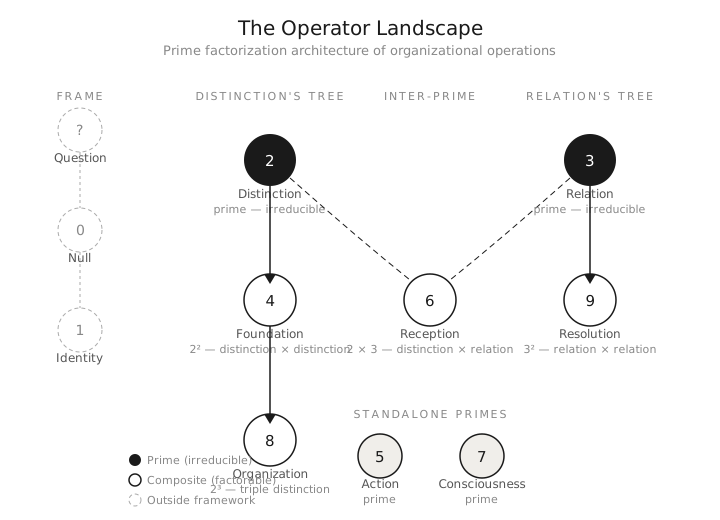
VISUAL CORRESPONDENCE: THE FACTORIZATION LANDSCAPE
As in Book I, the following is illustrative. The propositions do not depend on it.
The operator landscape can be visualized as a tree whose roots are the prime operators and whose branches are the composites:
From Operator 2 (Distinction) grows:
- Operator 4 (Foundation) = 2² — distinction’s first
- Operator 8 (Organization) = 2³ — distinction’s second
From Operator 3 (Relation) grows:
- Operator 9 (Resolution) = 3² — relation’s self-application
From the interaction of Operators 2 and 3 grows:
- Operator 6 (Reception) = 2 × 3 — their product
Operators 5 (Action) and 7 (Consciousness) stand as independent primes — they do not generate composites within the single-digit range. Whether they generate composites beyond it (10 = 2 × 5; 14 = 2 × 7; 15 = 3 × 5;
21 = 3 × 7; 35 = 5 × 7) is noted but not claimed. The landscape beyond 9 awaits its own verification.
What the visualization shows: the operator landscape is not a flat sequence (2, 3, 4, 5, 6, 7, 8, 9) but a structured hierarchy. Some operators are roots. Some are branches. The branching pattern is determined by prime factorization — by which irreducible capabilities interact to produce which composite capabilities. The landscape has a shape, and that shape is governed by the architecture this book has established.
GLOSSARY (ADDITIONS TO BOOK I)
Composite Operation: An operator whose resolution pattern decomposes into the interaction of simpler operators. Its capabilities are fully accounted for by its prime factors. It is structurally important but not irreducible. (Definition 9)
Identity (1): Resolution as operator — the neutral element that, applied to any operation, returns it unchanged. Neither prime nor composite. The multiplicative identity of the operator framework. Corresponds to the moment of arrival in each cycle: not a new capability but the resolution that reveals what existing capabilities have produced. (Definition 12)
Irreducible Operation (Prime): An operator representing a genuinely new axis of capability — one that cannot be produced by any combination of simpler operations. It may require previous operations as ground conditions (prerequisites) but is not composed of them. The atomic building blocks of the operator landscape. (Definition 8)
Operator: A stable pattern of orientation that persists across contexts as a reusable capability. Produced by the recursive cycle when a resolution pattern abstracts from its originating context. The z² that has separated from the +c. (Definition 7)
Prerequisite: An operator that must exist as ground condition for another operator’s possibility. Necessary for but not constitutive of the dependent operation. The formal distinction between prerequisite and composition is the basis for classifying operators as prime or composite. (Definition 10)
Primordial Pair (?, 0): The Question and the Null — the conditions for operation that are not themselves operations. The unresolved and the empty, which together make the operator framework possible. Outside the prime/composite classification. (Definition 11)